

Fire and smoke dampers are required by NFPA 80, NFPA 105, and the International Fire Code to be tested one year after installation, then every four years (every six years for hospitals). Skipping this testing is not just a code violation. It is a liability exposure that can follow a building owner straight into a courtroom if a fire ever tests a damper that was never actually tested.
Most people who work in a building every day have never noticed a fire or smoke damper. That is by design. They are tucked inside ductwork, hidden behind grilles, buried above ceiling tiles. But when a fire starts, these are some of the hardest working, least appreciated pieces of life safety equipment in the entire structure. Under NFPA 80, NFPA 105, and the International Fire Code, testing them is not optional. It is a legal requirement with a clear liability trail if it is ignored.
Here is what fire and smoke dampers actually do, what the codes require, what a real physical test looks like, and why "we will get to it next year" is one of the most expensive sentences a facility manager or building owner can say.
What Are Fire and Smoke Dampers, and Why Do They Matter?
A fire damper is a mechanical device installed inside HVAC ductwork, at the point where the duct passes through a fire-rated wall, floor, or partition. Under normal conditions, it sits open and lets air flow through the duct like any other section of ductwork. If a fire breaks out, a heat-activated fusible link melts at a set temperature and the damper's blades snap shut, sealing off that section of ductwork so fire cannot travel through the duct system into another compartment of the building.
A smoke damper works on a similar principle but responds to smoke rather than heat, typically triggered by a smoke detector or the building's fire alarm system rather than a fusible link. Many buildings also use combination fire and smoke dampers, which respond to both triggers and are held to the requirements of both standards.
| Damper type | What triggers it | Governing standard | Typical location |
|---|---|---|---|
| Fire damper | Heat, via a fusible link that melts at a set temperature | NFPA 80 | Ductwork penetrating fire-rated walls or floors |
| Smoke damper | Smoke detection or fire alarm signal | NFPA 105 | Ductwork penetrating smoke barriers |
| Combination fire/smoke damper | Both heat and smoke/alarm signal | NFPA 80 and NFPA 105 | Ductwork penetrating fire-rated smoke barriers |
The role these dampers play is bigger than most people realize. Modern buildings are divided into fire-rated compartments specifically so that a fire in one area does not immediately become a fire in every area. Ductwork is one of the few things that has to physically penetrate those fire-rated barriers to make HVAC systems work, which means every one of those penetrations is a potential weak point. Fire and smoke dampers are what keep that weak point from becoming the reason a contained fire turns into a building-wide event.
If a damper fails to close, whether because it is painted shut, corroded, blocked by debris, or was never installed or maintained correctly, the fire-rated compartmentalization the entire building design depends on stops working. Smoke and flame travel through the duct exactly where the building was designed to stop them.
What Codes and Standards Govern Damper Testing?
This is not a gray area or a best-practice suggestion. Fire and smoke damper testing is codified, specific, and enforceable.
NFPA 80, the Standard for Fire Doors and Other Opening Protectives, governs fire dampers. It requires functional testing at three stages: an operational test at installation, an acceptance test once the HVAC system is fully installed and running, and periodic testing on an ongoing schedule after that.
NFPA 105, the Standard for Smoke Door Assemblies and Other Opening Protectives, governs smoke dampers and combination fire/smoke dampers, with a parallel testing structure.
The International Fire Code (IFC), along with the International Building Code, incorporates both NFPA 80 and NFPA 105 by reference and places the legal obligation squarely on the building owner. The IFC requires that owners maintain fire- and smoke-resistance-rated assemblies, including their dampers, and keep records of every inspection and repair available for the fire marshal or other authority having jurisdiction (AHJ) to review.
Here is the testing schedule both standards land on:
| Requirement | Timing |
|---|---|
| First periodic test | One year after installation |
| Ongoing testing, most occupancies | Every four years |
| Ongoing testing, hospitals and certain healthcare occupancies | Every six years |
| Dedicated smoke control system dampers | More frequent testing, since they are not exercised through everyday HVAC operation |
The six-year interval for hospitals reflects an alignment between CMS and NFPA for facilities where damper access can be more disruptive to patient care. Dampers tied to dedicated smoke control systems, meaning the kind that actively manage smoke movement during an emergency rather than just closing when triggered, are often held to a tighter cadence for exactly that reason.
None of this runs on the honor system. Every test result, deficiency, and repair has to be documented and kept on file, because the AHJ can request that log at any time, and because that paper trail is exactly what gets pulled up after an incident.
What Does a Physical Fire Damper Test Involve?
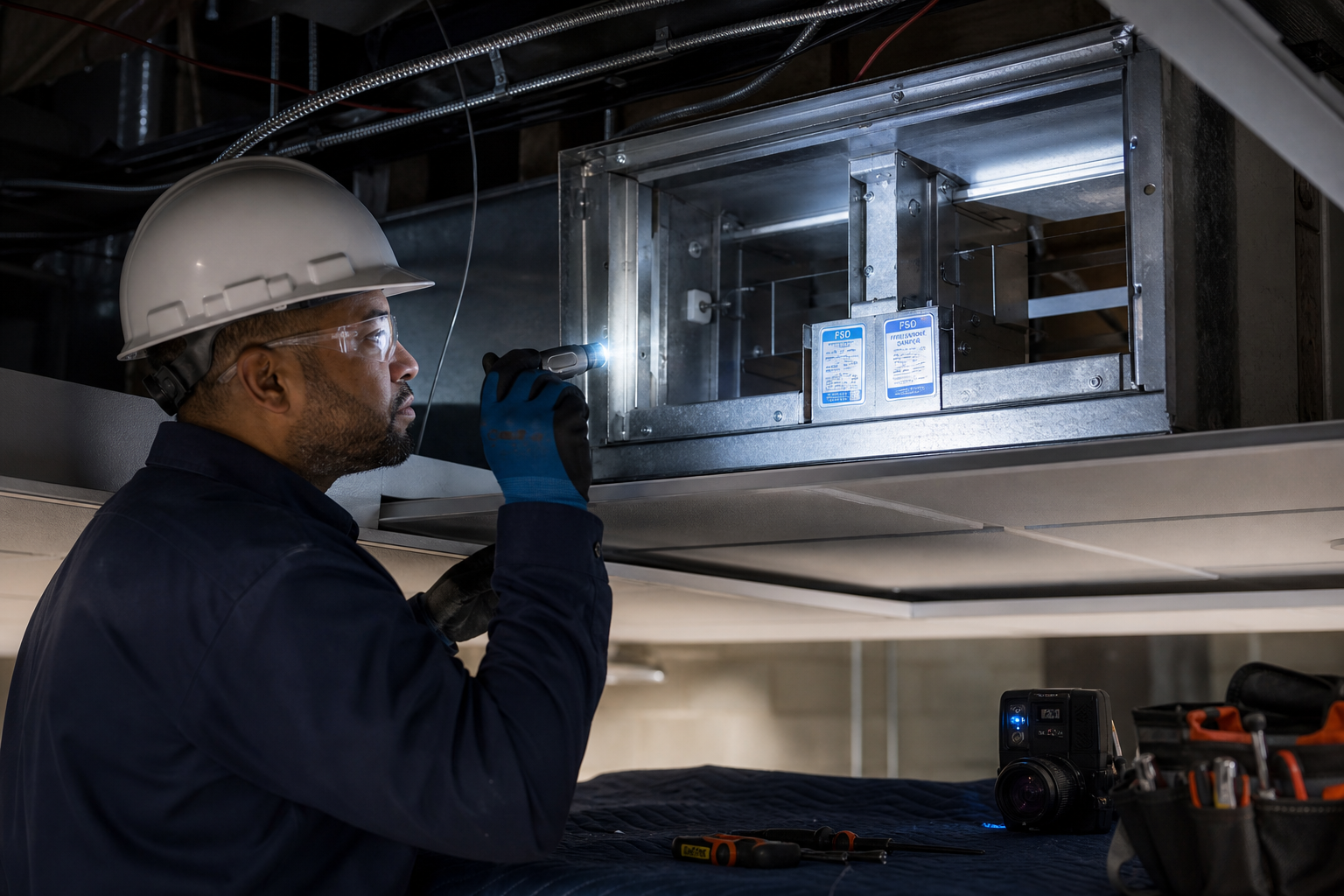
A damper test is not a glance through a ceiling tile. It is a hands-on, physical verification that the damper will do its job if it is ever called on for real. A proper test includes:
- Locating and accessing the damper, which often means opening ceiling tiles or duct access panels that have not been touched since the last test cycle.
- Verifying the damper's identification label is present and legible, since codes require dampers to be clearly marked for future access.
- Testing the release mechanism, meaning triggering the fusible link or the electronic actuator depending on the damper type, to confirm it responds correctly.
- Confirming the blades fully close and seal, with no obstruction, corrosion, paint buildup, or debris preventing complete closure.
- Resetting the damper and verifying it returns to its normal open position without binding or damage.
- Documenting the result: pass, fail, or repair needed, along with the specific deficiency if one exists.
This is where a lot of testing programs fall short, not because the test itself gets skipped, but because the documentation is thin. A checklist with a checkmark next to "damper #47: pass" does not hold up well to scrutiny after a fire, and it does not give a building owner much confidence between test cycles either.
That is why Aero Performance Group photographs every single damper we test: the label, the access point, and the damper in its tested condition, all as part of the permanent record. If a question ever comes up about a specific damper's condition on a specific date, whether from an AHJ, an insurance adjuster, or your own risk management team, there is a photo tied to that exact unit and that exact test, not just a line item on a spreadsheet. Our full fire and life safety testing process is built around this kind of documentation from the first inspection forward.
What Is the Liability If You Do Not Test, and a Fire Happens?
This is the part that does not get talked about enough. Skipping damper testing is not a paperwork risk. It is a liability risk that activates the moment a fire tests whether the building's compartmentalization actually works.
If a fire occurs and an untested or improperly maintained damper fails to close, the building's compartmentalization fails with it. Fire and smoke spread to areas they were never supposed to reach. That can mean more property damage, more injuries, and in the worst cases, loss of life, and every one of those outcomes carries a legal dimension once the cause is traced back to a damper that was never tested on schedule.
A few specific exposures worth understanding:
Negligence, and negligence per se. Building owners have a general legal duty of care to maintain the premises in a reasonably safe condition. When that duty is violated by ignoring a specific, codified requirement, such as the NFPA 80 and NFPA 105 testing intervals adopted into your local fire code, plaintiffs' attorneys do not have to argue the standard of care from scratch. The code violation itself can be used as direct evidence of negligence.
Civil liability that extends well past property damage. Owners found negligent after a fire can be held responsible for injury claims, wrongful death claims, business interruption losses suffered by tenants, and the effects on anyone in the building at the time, including employees, visitors, contractors, and first responders.
Insurance complications. Many commercial policies expect code-compliant life safety systems as a condition of coverage. An insurer investigating a fire loss will ask for damper testing records as a matter of course. Missing or incomplete records can become grounds for a coverage dispute at the exact moment a building owner needs that policy to perform.
Regulatory and occupancy consequences. Beyond litigation, an AHJ that discovers untested dampers, whether during a routine inspection or a post-fire investigation, can issue violations and fines, and in some cases restrict occupancy until the deficiency is corrected. For hospitals and healthcare facilities, failed life safety inspections also carry accreditation and CMS certification risk, which affects far more than a single building.
Damper testing is inexpensive and routine right up until the moment it isn't. After that, the cost is no longer a service invoice. It is liability exposure that did not need to exist.
Frequently Asked Questions
How often do fire dampers need to be tested?
Fire dampers must be tested one year after installation, then every four years for most buildings, or every six years for hospitals, per NFPA 80.
How often do smoke dampers need to be tested?
Smoke dampers follow the same schedule under NFPA 105: one year after installation, then every four years (six years for hospitals), with dedicated smoke control systems sometimes requiring more frequent testing.
Who is responsible for fire and smoke damper testing?
The International Fire Code places this responsibility on the building owner, who must ensure testing is performed and maintain documented records available to the authority having jurisdiction.
What happens if a fire damper isn't tested and a fire occurs?
An untested damper that fails to close can allow fire and smoke to spread beyond the compartment it was designed to contain, exposing the building owner to negligence claims, insurance disputes, and potential regulatory penalties.
What does a fire damper test actually involve?
A physical test includes accessing the damper, triggering its release mechanism, confirming full blade closure with no obstructions, resetting it to the open position, and documenting the result.
The Bottom Line
Fire and smoke dampers are quiet, unglamorous, and essential. The codes that govern their testing exist because the alternative has already played out in real buildings, with real consequences. NFPA 80, NFPA 105, and the International Fire Code do not leave this up to interpretation, and neither should the way it gets documented.
Aero Performance Group tests every fire and smoke damper to code, and we back every test with photo documentation so you have a real, defensible record, not just a checkbox, if anyone ever asks. If it has been a while since your last damper testing cycle, or you are not fully sure your records would hold up under scrutiny, let's take a look before it becomes a problem instead of a maintenance item.
Ready to get your damper testing program up to code? Contact Aero Performance Group to schedule an inspection.
Aero Performance Group is a family-owned mechanical and life safety services provider serving commercial, industrial, and healthcare facilities. Learn more at aeropg.com.

.png)